

Social Services Director Calls for Central Beneficiary Registry During Red Cross Week
Director of Social Services Department Supports Establishment of Central Beneficiary List for Emergencies
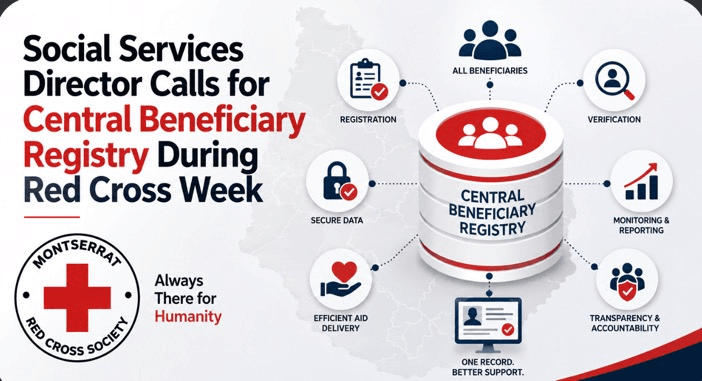
Social Services Director Calls for Central Beneficiary Registry During Red Cross Week Opening — The Director of the Social Services Department is calling for the establishment of a central beneficiary list before any emergencies or disasters occur, making the case during her address at the start of Montserrat Red Cross Week.
Quick Facts
Teresena Fergus, who heads the Social Services Department, used the platform of Montserrat Red Cross Week to put forward a compelling case for creating a verified and updated registry of vulnerable persons that could be activated immediately when disasters strike the island.
She was addressing the start of Montserrat Red Cross Week in observation of Red Cross and Red Crescent Day 2026 on May 8—a day dedicated to recognising humanitarian work worldwide and promoting disaster preparedness.
"A verified and updated registry would reduce delays, improve coordination, prevent duplication, strengthen transparency, and allow vulnerable persons to receive assistance more quickly and systematically."
— Teresena Fergus, Director of Social Services
Fergus contends that such a registry is essential for effective emergency response. Among the benefits she outlined, Mrs Fergus says a proper registry will supply better planning, accountability, and evidence-based decision-making during emergencies.
She detailed five key advantages that a central beneficiary list would provide. First, the registry would eliminate delays that currently occur when officials must rush to identify and locate vulnerable persons in the immediate aftermath of a disaster.
Second, improved coordination among government agencies, non-governmental organisations, and international partners would ensure that resources are deployed efficiently without overlap or gaps in coverage.
Third, preventing duplication of benefits would stretch limited emergency resources further, ensuring that aid reaches the maximum number of people in need rather than being concentrated among those who may be registered multiple times across different systems.
Fourth, enhanced transparency in the distribution of emergency assistance would build public confidence in the government's disaster response capabilities and ensure accountability in how resources are allocated.
Fifth, and perhaps most importantly, vulnerable persons—including the elderly, persons with disabilities, and those with chronic medical conditions—would receive assistance more quickly and systematically, potentially saving lives when every moment matters.
The call for a central beneficiary registry aligns with broader regional efforts to improve disaster preparedness across the Caribbean, where small island developing states face disproportionate risks from hurricanes, volcanic activity, and other natural hazards.
Montserrat's own history with the Soufrière Hills Volcano has demonstrated the critical importance of having robust systems for identifying and assisting vulnerable populations during prolonged crises. The proposed registry would represent a significant step forward in the island's emergency management capabilities.
What This Means for Montserrat ResidentsA central beneficiary registry would create a more efficient and equitable system for delivering emergency assistance to those who need it most during disasters. Residents who are elderly, have disabilities, or require special medical care would be pre-identified, allowing for faster response times.
The registry would improve coordination between government agencies and relief organisations, reducing confusion and ensuring that resources are distributed fairly and transparently when emergencies occur.
For the broader community, this initiative represents another step in Montserrat's ongoing efforts to strengthen its disaster preparedness and protect its most vulnerable citizens.
Source: ZJB Radio |
Stay up to date with our local news!
Get articles like this delivered to your inbox.
Subscribe Now
0 Comments
Join the conversation
Be the first to comment
Share your thoughts above.