

MVO Research Reveals New Insights into 2021 La Soufrière Eruption | Montserrat Shout Outs
Study published in Volcanica journal identifies magma storage depths of 2.4-8.9 km and volatile emissions from St. Vincent's explosive eruption.
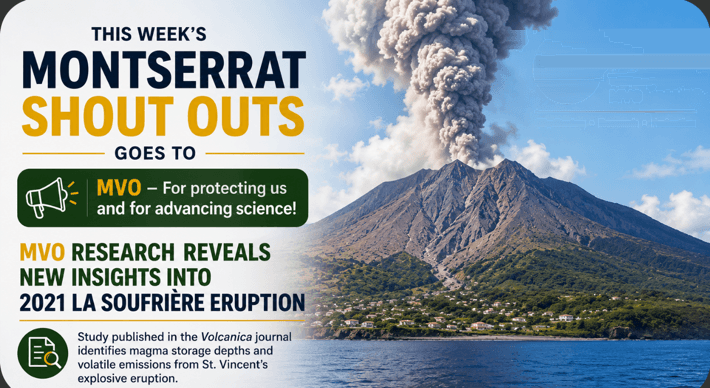
New research from the Montserrat Volcano Observatory (MVO) and international collaborators has provided the first comprehensive analysis of volatile emissions and magma storage conditions during the 2021 explosive eruption of La Soufrière volcano in St. Vincent. The study, published in the peer-reviewed journal Volcanica on 18 May 2026, reveals critical insights into the magmatic processes that drove the dramatic transition from lava dome effusion to hazardous explosive activity, offering valuable lessons for volcanic monitoring across the Eastern Caribbean region.
Quick Facts
The VEI 4 eruption underwent a significant and potentially dangerous transition in eruption style, beginning with relatively quiet lava dome effusion in December 2020 before shifting dramatically to explosive activity in April 2021. This type of transition poses unique challenges for volcano monitoring teams, as the change in eruptive behaviour can occur with limited warning. Understanding these magmatic processes is essential for improving volcanic hazard assessment and evacuation planning in the Eastern Caribbean, where multiple islands host active or potentially active volcanic systems.
The research team, led by TiVonne Howe of the Montserrat Volcano Observatory, included distinguished scientists from the Seismic Research Centre at The University of the West Indies (UWI) in Trinidad and Tobago, Université Clermont Auvergne in France, Lancaster University in the United Kingdom, and the University of Plymouth in the UK. This international collaboration demonstrates the global scientific community's commitment to understanding volcanic hazards in the Caribbean region and highlights the critical role that Montserrat's volcano observatory plays in regional monitoring efforts.
The study provides groundbreaking first measurements of pre-eruptive total carbon dioxide at La Soufrière and detailed estimates of magmatic temperature. Using the sophisticated petrological method, researchers quantified substantial volatile fluxes to the atmosphere totalling 5.40 ± 0.60 megatonnes of water (H₂O), 0.37 ± 0.04 megatonnes of carbon dioxide (CO₂), 0.13 ± 0.01 megatonnes of sulfur dioxide (SO₂), and 0.33 ± 0.04 megatonnes of hydrogen chloride (HCl). These findings represent a significant contribution to understanding volcanic gas emissions, their environmental impact, and their potential effects on regional climate patterns and air quality during major eruptive events.
Advanced modelling of volatile saturation pressures indicates final magma storage depths ranging from 2.4 to 8.9 kilometres below the surface, with a mean depth of 6.4 kilometres, throughout four distinct phases of explosive activity. This pattern followed the migration of magma within the lower storage region of what scientists describe as a transcrustal mush system—a complex network of magma chambers and conduits that feed volcanic eruptions. The inferred depths are remarkably consistent with recorded seismicity and ground deformation observed before and during the explosions, providing strong validation for the geological models used by volcano monitoring teams to forecast eruptive behaviour.
"Understanding the magmatic processes underpinning such transitions is critical for volcanic hazard assessment and eruption forecasting in the Eastern Caribbean. The integration of melt inclusion data with seismic and deformation monitoring provides a powerful tool for reconstructing pre-eruptive conditions."
— Howe et al., Volcanica 2026
The research demonstrates the significant value of melt inclusion analysis—a technique that examines tiny pockets of trapped magma within crystals—in reconstructing pre-eruptive magma storage conditions with remarkable precision. This methodology, applied here to the 2021 La Soufrière eruption, provides a proven template for studying future volcanic events in the region and could be instrumental in improving eruption forecasts. The successful collaboration between the Montserrat Volcano Observatory and international research institutions highlights the importance of sustained regional scientific cooperation in addressing volcanic hazards across the Caribbean, particularly for islands with active monitoring systems.
For Montserrat specifically, the findings carry particular relevance. The island's own Soufrière Hills Volcano, monitored continuously by MVO, shares geological similarities with La Soufrière in St. Vincent. Both volcanoes are part of the Lesser Antilles volcanic arc and exhibit similar eruption styles, including dome growth and explosive transitions. The research methodologies validated in this study can be directly applied to enhance monitoring capabilities at Montserrat's volcano, potentially improving early warning systems and hazard assessments that protect local communities.
What This Means for Montserrat ResidentsThe advanced research methodologies used in this study are directly applicable to the Soufrière Hills Volcano on Montserrat, potentially enhancing local monitoring capabilities and improving eruption forecasting accuracy.
The Montserrat Volcano Observatory's leadership role in this regional study strengthens scientific understanding of volcanic systems across the Eastern Caribbean and reinforces MVO's reputation as a centre of excellence in volcano monitoring.
Improved knowledge of magma storage depths and volatile emission patterns contributes to better eruption forecasting, more effective hazard preparedness planning, and enhanced community safety for Montserrat residents living near the volcano.
|
Stay up to date with our local news!
Get articles like this delivered to your inbox.
Subscribe Now
0 Comments
Join the conversation
Be the first to comment
Share your thoughts above.