

CARPHA Issues Hantavirus Watching Brief Update for Caribbean
CARPHA updates Caribbean on Hantavirus outbreak monitoring; regional risk remains LOW
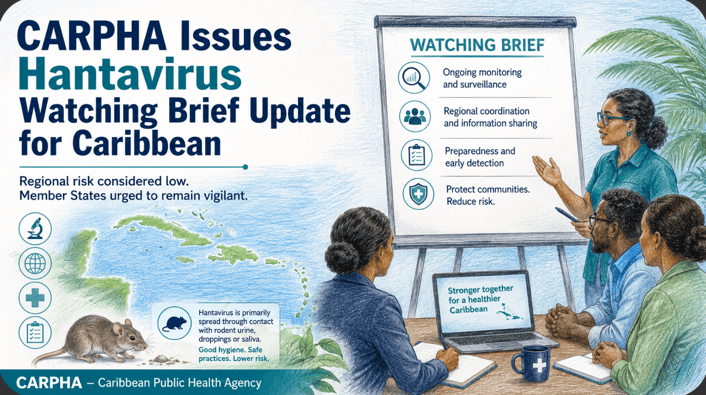
The Caribbean Public Health Agency (CARPHA) has issued an updated Watching Brief on Hantavirus as the outbreak associated with the MV Hondius cruise ship continues to be monitored internationally. While the regional risk to the Caribbean remains LOW, CARPHA urges Member States to maintain vigilance and strengthen surveillance measures.
Quick Facts
The outbreak originated aboard the MV Hondius, a cruise ship that departed Ushuaia, Argentina on April 1, 2026. The first case developed symptoms on April 6, just five days after departure. Tragically, the first passenger died on board on April 11. A second death occurred on April 26 in South Africa, involving the wife of the first victim, who had disembarked in St. Helena on April 24.
On May 2, the ship alerted the World Health Organisation (WHO), and by May 3, CARPHA issued a TalkWalker Alert. The virus was subsequently confirmed as Andes hantavirus on May 6 — the only hantavirus strain known to rarely permit limited human-to-human transmission. CARPHA immediately released a media release and launched its Hantavirus Watching Brief to keep Member States informed.
"The principal wild rodent vector reservoirs associated with Andes hantavirus transmission are documented as absent in the Caribbean region. Hantaviruses are highly host-specific and primarily transmitted by wild rodents, not common urban rats."
— CARPHA Hantavirus Watching Brief
The Andes hantavirus is primarily transmitted through exposure to infected rodent urine, droppings, saliva, or aerosolised particles. Human-to-human transmission is rare and requires prolonged, close contact in enclosed spaces. There is no efficient airborne community spread, and the virus does not pose a pandemic threat.
CARPHA's risk assessment confirms that the Caribbean risk remains LOW for several key reasons. First, the principal wild rodent vector reservoirs associated with Andes hantavirus transmission are absent in the Caribbean region. Second, hantaviruses are highly host-specific and primarily transmitted by wild rodents, not common urban rats. Third, links to cyclic rodent populations and hantavirus disease surveillance have been limited in the Caribbean.
However, vigilance remains essential. The Caribbean is the world's leading cruise tourism destination with substantial movement of international travellers through ports of entry. The semi-enclosed environments of cruise vessels can facilitate the introduction and transmission of infectious diseases. CARPHA has activated its Incident Management-Emergency Response (IMT-ER) team and continues to monitor the situation closely.
Hantavirus Pulmonary Syndrome (HPS), the clinical syndrome associated with this outbreak, initially presents with nonspecific flu-like symptoms, including fever, headache, fatigue, and muscle pain. These symptoms can rapidly progress to respiratory distress and cardiopulmonary failure. The incubation period is generally 1-6 weeks, and the case fatality rate ranges from 30-50% depending on the virus strain and clinical management.
There is no specific antiviral treatment currently available for hantavirus infection, and no licensed vaccine is widely available for prevention. Early supportive medical care significantly improves outcomes. Laboratory confirmation can be achieved through serological detection of hantavirus-specific IgM antibodies or detection of viral RNA by RT-PCR in acute-phase specimens.
CARPHA recommends that Member States continue enhanced surveillance of vessels entering ports, conduct routine vessel inspections, review Maritime Declaration of Health documentation, and strengthen rodent control and deratting procedures at ports and on vessels. Medical personnel should use appropriate infection prevention and control precautions, and suspected cases should be isolated and medically assessed promptly.
What This Means for Montserrat ResidentsThe overall risk of hantavirus to Montserrat and the Caribbean region remains LOW. The natural rodent hosts required for Andes hantavirus transmission are not present in our region, significantly reducing the likelihood of local transmission.
However, residents should remain aware of general public health measures, including maintaining proper sanitation, avoiding exposure to rodent droppings or nesting materials, and seeking early medical evaluation if experiencing severe respiratory symptoms, particularly after recent travel to affected areas.
The Ministry of Health continues to monitor the situation through CARPHA and WHO channels. Any updates or changes to local guidance will be communicated through official government channels.
Source: Caribbean Public Health Agency (CARPHA) - Hantavirus Watching Brief Update #2, May 15, 2026 |
Stay up to date with our local news!
Get articles like this delivered to your inbox.
Subscribe Now
0 Comments
Join the conversation
Be the first to comment
Share your thoughts above.