

WHO Declares Public Health Emergency Over Bundibugyo Ebola Outbreak in DRC and Uganda
The World Health Organization has upgraded the risk assessment to Very High at the national level as cases spread across 16 health zones in the Democratic Republic of the Congo.
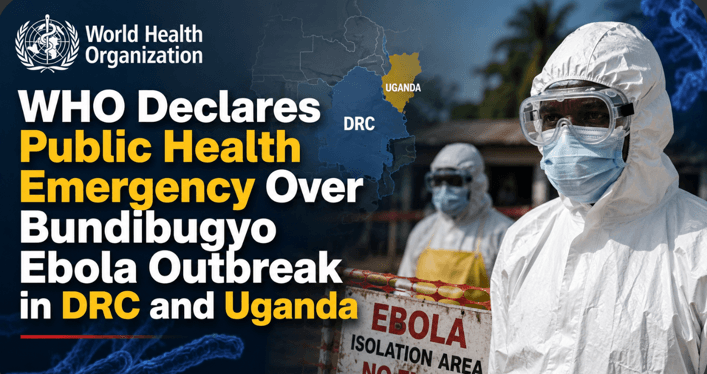
The World Health Organisation has declared the Bundibugyo virus disease outbreak in the Democratic Republic of the Congo (DRC) a Public Health Emergency of International Concern (PHEIC) following rapid geographic expansion and confirmed cross-border transmission to Uganda. The updated risk assessment released on 22 May 2026 classifies the national risk level as "Very High" for DRC, "High" regionally, and "Low" globally.
Quick Facts
The outbreak has expanded dramatically from 3 health zones on 15 May to 16 health zones across 3 provinces by 21 May 2026. Affected areas include 12 health zones in Ituri Province, 3 in North Kivu, and 1 in South Kivu. The first case is believed to be a nurse who died on 24 April 2026 in Bunia health zone, with subsequent infections among 8 healthcare workers and a family cluster of 15 deaths within two weeks.
Uganda confirmed 2 imported cases in Kampala, including one death. The first case involved an elderly male from DRC who travelled to Uganda seeking care on 11 May and died on 14 May. A second unrelated case is receiving care at an Ebola isolation unit. Approximately 126 contacts have been identified in Uganda with a 90.9% follow-up rate.
This marks only the third documented Bundibugyo virus outbreak globally, following outbreaks in Uganda in 2007-2008 and in DRC in 2012. Unlike previous Ebola outbreaks, no licensed vaccine or therapeutics exist for the Bundibugyo virus - existing Ebola virus vaccines and treatments are not effective against this strain. The case fatality rate for this outbreak is 24.2% among suspected cases, though investigations are ongoing.
"Given the evolving epidemiological situation of the current Ebola disease outbreak caused by Bundibugyo virus in the Democratic Republic of the Congo with exportation to Uganda, the initial rapid risk assessment on 15 May 2026 has been updated to incorporate newly available information, including recent epidemiological developments, cross-border implications, and the declaration of the event as a Public Health Emergency of International Concern."
-- WHO Rapid Risk Assessment, 22 May 2026
What This Means for Montserrat ResidentsWhile the global risk remains low and Montserrat is geographically distant from the outbreak zone, this event highlights the importance of robust infectious disease surveillance and preparedness in our region.
The rapid spread from 3 to 16 health zones in just six days demonstrates how quickly novel pathogens can escalate when healthcare infrastructure is strained, and community trust is low.
For travellers, the WHO advises against non-essential travel to affected areas in eastern DRC and urges vigilance for symptoms (fever, headache, vomiting, weakness) within 21 days of return from the region.
|
Stay up to date with our local news!
Get articles like this delivered to your inbox.
Subscribe Now
0 Comments
Join the conversation
Be the first to comment
Share your thoughts above.